Many people ask whether dental implants are the best option for missing teeth. This post looks at that question in plain terms. You’ll learn what implants are, how they compare to bridges and dentures, the main benefits and downsides, who makes a good candidate, and how modern tech improves results. By the end, you’ll know whether dental implants or another choice is likely right for you.
What Are Dental Implants?
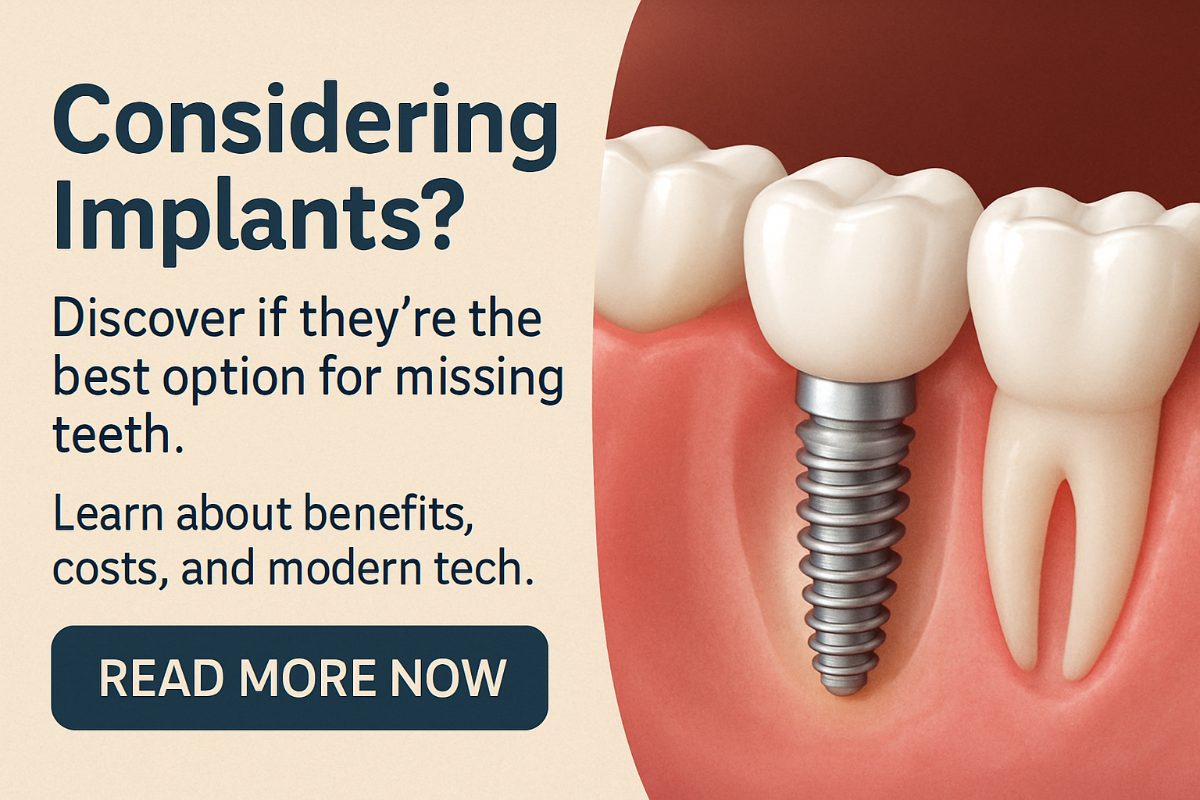
Dental implants are small titanium fixtures placed in the jaw to serve as a tooth root. An abutment attaches to the implant, and a crown (or bridge or denture) sits on top. Implants restore chewing, speech, and appearance by replacing both the root and the visible tooth. Because they bond with bone, they also help preserve jaw volume over time.
How Dental Implants Compare To Other Options
Dental Bridges
A dental bridge replaces a missing tooth with a false tooth held by crowns on neighboring teeth. Bridges work well for one or two missing teeth but require altering adjacent healthy teeth. They don’t prevent bone loss at the missing root as an implant does.
Partial Dentures
Removable partial dentures are a lower-cost, faster option. They clip onto remaining teeth and can replace several missing teeth. Downsides include a less stable fit, more upkeep, and ongoing bone loss where roots are missing. For some patients, partials are a reasonable short-term choice.
Full Dentures
Full dentures replace all teeth in an arch. They restore appearance and basic function but typically feel less natural and offer a weaker chewing force than implants. Over time, dentures can become loose as the jawbone shrinks unless they’re supported by implants.
Are Dental Implants the Best Option For Missing Teeth?
Key Benefits
Implants are often the best option for missing teeth because of their durability, natural feel, and bone-preserving properties. Well-placed implants can last many years with routine care, improve chewing efficiency, and boost confidence. Over the long term, implants can be more cost-effective than repeatedly replacing other restorations.
When Implants Might Not Be the Best Option
Implants are not ideal for everyone. Upfront cost and the need for surgery are common barriers. Some patients lack sufficient jawbone or have medical issues (like poorly controlled diabetes or heavy smoking) that raise risk. In those cases, bridges or removable options may be safer or more practical.
Who Is a Good Candidate?
Good candidates are generally in good overall health, have healthy gums, and enough jawbone to hold an implant. Smoking, uncontrolled chronic disease, or active gum disease can reduce success. Older age alone is not a disqualifier. When bone is limited, preparatory treatments such as bone grafts or extractions can make implants possible.
How Modern Technology Improves Implant Outcomes
Tools like CBCT 3D imaging, digital treatment planning, and surgical guides increase safety and accuracy. CAD/CAM restorations, in-house milling, and high-resolution 3D printing speed up the process and improve fit and esthetics. These technologies reduce surprises and shorten treatment time.
Questions to Ask Your Dentist Before Choosing Implants
Ask about the doctor’s implant experience and success rates, whether CBCT and surgical guides will be used, the expected timeline from surgery to final restoration, detailed costs and financing, and alternative options for your case. Also, confirm what preparatory work might be needed.
About Lalor Implant Center and Dr. Joe Lee
Lalor Implant Center in Vestal, NY, is led by Dr. Joe Lee, a board-certified prosthodontist and implant expert. The practice uses CBCT, CAD/CAM, milling, and 3D printing within a digital workflow to plan and deliver implant care with predictable, esthetic results.
Next Steps / Short CTA
If you’re wondering whether implants are the best option for missing teeth in Vestal, NY, schedule a consultation. A personalized plan with digital imaging will clarify your options, costs, and timeline so you can choose the right path for your health and smile.