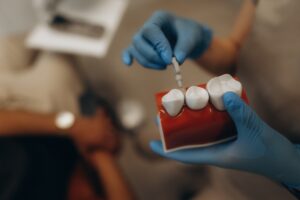

An “ailing” implant is one showing early signs of trouble, like inflammation or minor bone loss, that can often still be treated and saved with prompt care. A “failing” implant has progressed to the point where it’s loose, unstable, or no longer functioning properly, and usually requires removal or replacement. Catching problems at the ailing stage, through good oral hygiene and regular checkups, is what most often prevents an implant from progressing to failure.
Dental implants are built to last, but like any part of your mouth, they still need attention. Knowing the difference between an implant that’s struggling but salvageable and one that’s truly failing can be the difference between a simple fix and a much bigger procedure.
What Does It Mean for an Implant to Be “Ailing”?
An ailing implant is showing early warning signs of a problem, most commonly gum inflammation, minor bleeding, or the earliest stages of bone loss around the implant, sometimes called peri-implantitis when it involves the surrounding bone and tissue. At this stage, the implant itself is usually still stable, and with prompt treatment, it can often be brought back to full health.
What Does It Mean for an Implant to Be “Failing”?
A failing implant has progressed well beyond early warning signs. It may feel loose, cause ongoing pain or discomfort, or simply no longer function the way it should. At this point, the surrounding bone has typically been compromised enough that saving the original implant isn’t realistic, and removal followed by evaluation for a replacement becomes the more likely path forward.
Why Missing Teeth Matter Beyond Appearance
Missing teeth create both physical and emotional challenges, affecting chewing, nutrition, speech, and social confidence. That’s part of why dental implants are considered such a transformative solution in the first place, offering stability that traditional dentures often can’t match. It’s also why protecting an implant once it’s placed matters just as much as the procedure itself.
Best Practices for Keeping Your Implant Healthy
Regular brushing and flossing remain essential to keep implants free from the plaque buildup that leads to gum issues. Consistent dental checkups allow small problems to be caught early, before they progress from ailing to failing. A balanced diet and avoiding smoking both support long-term implant health as well, since smoking in particular is linked to higher rates of implant complications.
The Risks of Skipping Maintenance
Left unaddressed, an ailing implant can progress to gum inflammation and recession, peri-implantitis, bone loss, ongoing pain, and eventually a loose or failing implant that requires a costly corrective procedure. Nearly all of these risks are far easier to manage, and far less expensive, when caught early.
When to Call Your Dentist
Any new bleeding, swelling, discomfort, or looseness around an implant is worth a call rather than a wait-and-see approach. Catching an ailing implant early is almost always simpler to treat than waiting until it’s progressed toward failure.
Frequently Asked Questions
Can an ailing implant really be saved? In many cases, yes. Ailing implants caught early, showing inflammation or minor bone loss, often respond well to treatment and can return to full health with prompt care.
What are the earliest warning signs I should watch for? Gum inflammation, minor bleeding around the implant site, and any new sensitivity are all worth mentioning to your dentist rather than waiting to see if they resolve on their own.
What happens if an implant fully fails? A failing implant, one that’s loose or no longer functioning, typically needs to be removed. From there, your dentist can evaluate whether a replacement implant is a realistic option.
Does smoking really affect implant health? Yes, smoking is linked to higher rates of implant complications and can make it harder for an ailing implant to recover once problems start.
How often should I have my implants checked? Regular dental checkups, along with daily brushing and flossing, are the best way to catch small issues before they progress. Your dentist can recommend a specific schedule based on your history.
Who should I see if I think my implant is ailing or failing? A prosthodontist with implant-specific training, like Dr. Joe Lee, is well-suited to evaluate and treat implant complications, including cases that may need more than routine care.
Concerned About One of Your Implants?
Schedule an appointment at Lalor Implant Center in Vestal, NY, and we’ll evaluate whether your implant can be treated or needs a different approach.