
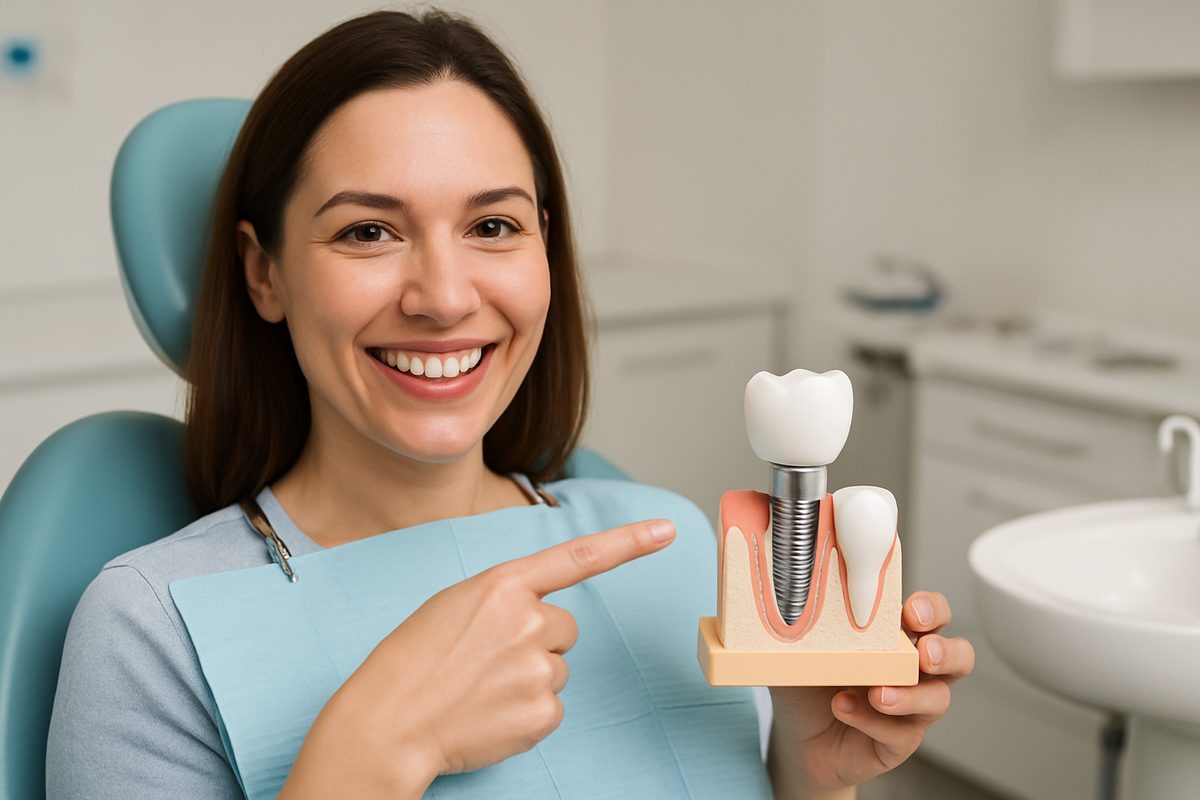
Understanding the meaning of implants helps you decide whether dental implants are right for you. This guide explains in plain language what implants are, why they matter for eating, speech, and jaw health, and what to expect during treatment. In short, the implants serve as replacement tooth roots — small posts (usually titanium or ceramic) placed in the jaw to hold a crown, bridge, or denture.
What “implants” means: definition and simple explanation
Medically, implants are titanium or ceramic posts surgically placed into the jawbone to fuse with bone and act like natural tooth roots. Commonly, the term “implant” refers to three parts: the implant (the post in the bone), the abutment (the connector), and the crown or prosthetic (the visible tooth or denture). Together, they replace missing teeth safely and predictably.
Common types of dental implants
Endosteal implants
Endosteal implants are the most common root-form type. They look like screws or cylinders and are used to replace single teeth, support bridges, or anchor dentures. They work well when there is enough bone.
Subperiosteal and other specialized implants
Subperiosteal implants sit on the bone beneath the gum and are used when the jawbone is too shallow. In severe bone loss, zygomatic implants anchor in the cheekbone. These are less common but useful alternatives.
Implant‑supported restorations
Implant-supported restorations include single crowns, multi-tooth bridges, and full-arch solutions like All-on-4. Crowns replace one tooth; bridges span several; implant dentures can be fixed or removable, offering more stability than traditional dentures.
Who is a good candidate?
Good candidates generally have healthy gums, enough jawbone, and controlled medical conditions. Non-smokers or those willing to quit have better outcomes. Conditions like uncontrolled diabetes or recent radiation to the head/neck may need medical clearance. Low bone density can be treated with bone grafts or sinus lifts to allow implants.
Step-by-step: what to expect during implant treatment
Assessment and planning
Your dentist will take digital X-rays or a CBCT scan to assess bone and plan implant position. Digital planning helps predict results and create surgical guides.
Surgery and healing
Implant placement is usually an outpatient procedure. The implant is placed in bone, then left to heal while osseointegration (bone bonding to the implant) occurs, typically for several months. Follow-up visits check healing.
Final restoration
After healing, an abutment is attached, and impressions or digital scans are taken for the crown, bridge, or denture. The final restoration is fitted and adjusted for comfort and function.
Benefits, risks, and longevity
Benefits include chewing stability, preserved bone, improved speech, and a natural feel. Risks can include infection, implant failure, or the need for additional surgery. With proper care, implants often last many years—commonly 10–30+ years—though crowns may need replacement sooner. Regular dental visits and good hygiene are essential.
How modern technology improves outcomes
CBCT imaging, CAD/CAM design, in-house milling, and 3D printing improve precision and fit. They allow detailed planning, accurate surgical guides, faster lab work, and better-looking restorations, reducing complications and chair time.
About Dr. Joe Lee and Lalor Implant Center
Dr. Joe Lee, DDS, MDS, FACP, is a board-certified prosthodontist and Diplomate of the American Board of Prosthodontics. Lalor Implant Center uses CBCT, CAD/CAM, milling, and 3D printing to deliver predictable implant care with a focus on function and esthetics.
Next steps: questions to ask and how to learn more
During a consult, ask about the doctor’s implant experience, success rates, digital workflow, and financing options. If you’re ready, schedule an evaluation to review your imaging and get a personalized plan to learn how implants can help you.